
Iris Technology Validates Flawless Performance with Thales LPT 6510 Space Cryocooler
FOR IMMEDIATE RELEASE
Irvine, CA – Jan 6, 2026 – Iris Technology announces successful validation testing of its flight-proven ICE-G2-100I Cryocooler Control Electronics (CCE) with the Thales Cryogenics LPT 6510 pulse-tube first-generation space cryocooler, demonstrating exceptional performance and compatibility for next-generation space missions.
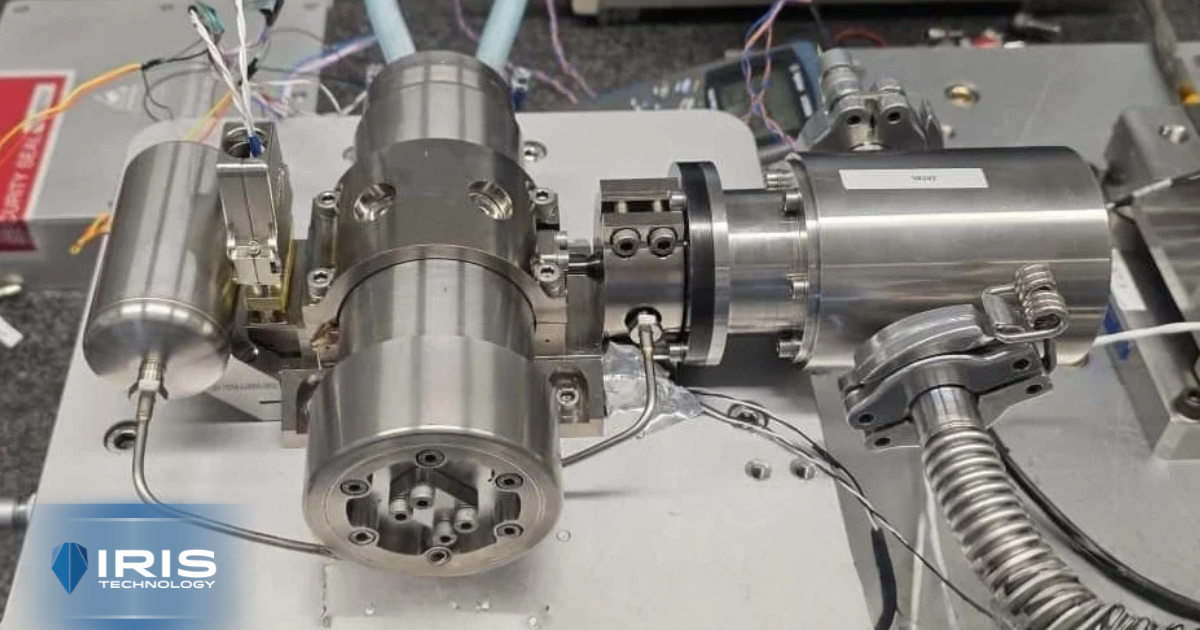
Testing conducted in November 2025 at Thales Cryogenics facilities in the Netherlands validated flawless operation across multiple control modes, with the ICE-G2-100I achieving vibration cancellation below 100 mN—critical performance for high-precision infrared imaging and Earth observation missions where mechanical disturbances directly impact image quality.
Proven Integration for Mission-Critical Applications
The comprehensive test campaign evaluated the TRL 8-qualified ICE-G2-100I controlling the Thales LPT 6510 in both temperature and voltage modes, input ripple filtering, and active vibration cancellation. The LPT 6510 is designed for space applications requiring cool down temperatures between 60 and 150 Kelvin, making it ideal for infrared detectors in Earth observation, planetary science, and national security missions.
The validation demonstrates that mission designers can confidently integrate this proven combination, reducing technical risk and accelerating development timelines. The pairing offers spacecraft integrators a de-risked thermal management solution backed by flight heritage and demonstrated compatibility.
Advanced Control Capabilities
The ICE-G2-100I, highly leveraging the TRL 9 architecture of the ICE-G2-60 and ICE-G2-200I, provides comprehensive cryocooler management enhanced with mission-enabling features critical for modern space systems:
Active Vibration Control: Real-time 5-harmonic vibration analysis between accelerometer or force transducer feedback and compressor drive enables dynamic voltage adjustment, achieving the sub-100 mN disturbance levels essential for image stabilization in high-resolution optical systems.
Input Ripple Filter (IRF): Reduces conducted emissions and noise to the spacecraft power bus, ensuring electromagnetic compatibility in complex payload environments and protecting sensitive onboard electronics.
"Testing the ICE-G2-100I with the Thales LPT 6510 in the Netherlands demonstrated flawless performance across all operating modes," said Andrea Lackey, Director of Business Development & Product at Iris Technology. "This validated compatibility gives our customers a proven, de-risked thermal management solution they can integrate with confidence."
About Iris Technology
Iris Technology designs and delivers mission-critical aerospace control electronics and imaging solutions for government and commercial space programs worldwide. With extensive flight heritage supporting NASA planetary missions, national security space systems, and Earth observation satellites, Iris Technology specializes in radiation-hardened electronics that enable reliable operation in the harshest space environments.
For technical specifications and integration guidance, visit www.iristechnology.com/aerospace.
Media Contact:
Jennifer Frohling
Marketing Communications Specialist
Iris Technology
jfrohling@iristechnology.com
Technical Inquiries:
Kristin Malenfant
Principal Systems Engineer IV, Manager
Iris Technology
kmalenfant@iristechnology.com
###